
Kolak Biji Salak – Sweet Potato Balls

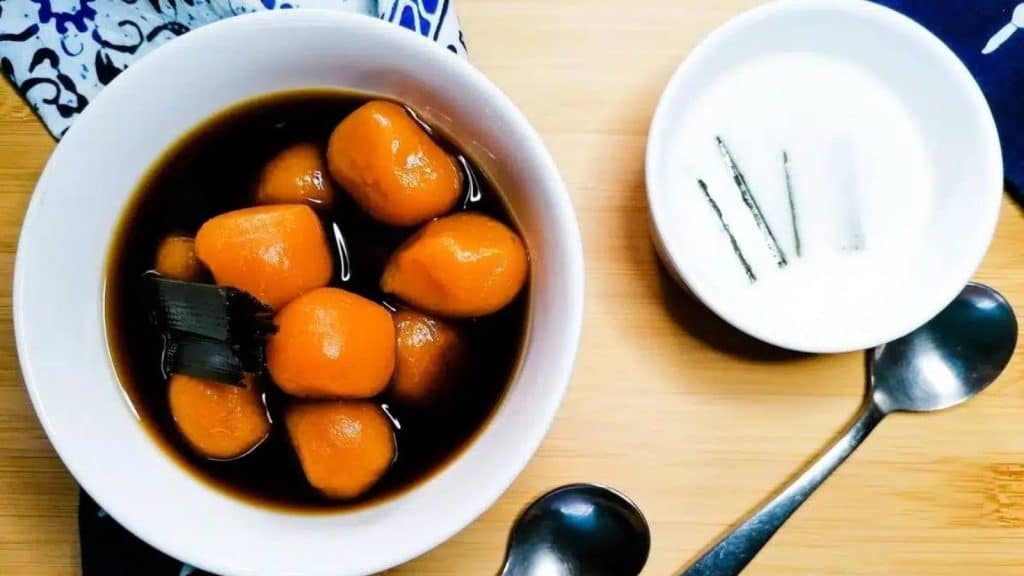
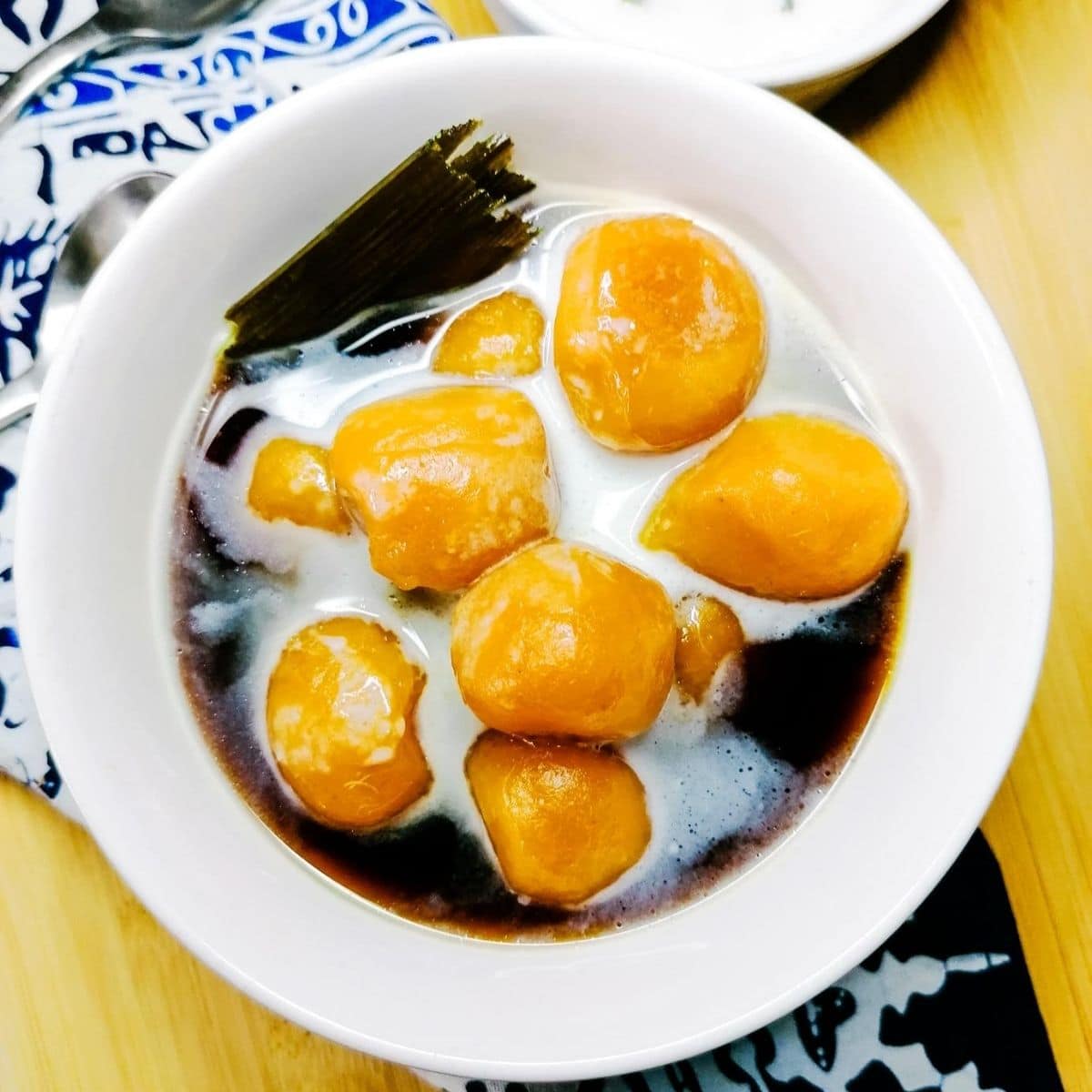
Kolak Biji Salak is an Indonesian sweet snack made of sweet potato dumpling balls in palm sugar syrup and coconut milk.
In Indonesia, many kinds of desserts made with all sorts of different things are eaten with palm sugar syrup and coconut milk. This type of dessert is called kolak. Some popular ones are Kolak Pisang (Pisang means banana), Kolak Ubi (Ubi means sweet potato), and Kolak Biji Salak, which are sweet potato balls.

The latter can be tricky to explain because Biji Salak means Salak’s seed.
Salak – also known as snake fruit due to its scaly skin – is a fruit from the palm tree family and is native to some Indonesian regions. It has brown, scaly skin with beige, garlic-like lobes of fruit flesh inside. And each lobe has a large brown seed that looks like a stone. It is from this seed that Kolak Biji Salak’s name comes.
So yeah, although it may sound like a merry-go-round for me to explain, I hope you understand why the recipe I’m sharing here has a funny name.
Traditionally, Indonesians enjoy Kolak more than ever at Iftar during the fasting month of Ramadan. After a long day of fasting, people break their fast with something sweet, and Kolak is one of the many popular options.
However, Kolak is also a popular afternoon snack, enjoyed with a cup of freshly brewed Indonesian coffee. Ahh, it reminds me of my dad now.
Anyway, I chose to share the Kolak Biji Salak recipe this time around. Not only is it my favorite Kolak (pardon my selfishness?), But it is also something new to many people. So, I want to challenge your taste buds for a new food adventure. I promise I will share more Kolak recipes in the future.
If you love anything with sweet potatoes, you might want to try this sweet potato pound cake, too.
The Ingredients You Need
Sweet Potatoes
There are several types of sweet potatoes. This recipe uses the most common type: sweet potato with orange flesh.
Tapioca Flour
This is one of the principal ingredients of the recipe. Tapioca flour is made from cassava starch and is slightly different from its cousin, Cassava flour. Because cassava flour is made of the whole root of cassava, it has more fiber.
I’ve never replaced this tapioca flour with any other grain flour. Healthline’s website suggests substituting tapioca flour with another 6 types of flour. You can check their article here.
Sugar
The original recipe uses palm sugar, but you can substitute it with dark muscovado sugar or dark soft brown sugar.
Coconut milk
In Indonesia, people make their coconut milk from freshly grated coconut. You can do the same if you want. But for practicality, let’s use tinned coconut milk. Just make sure you choose a good quality one.
Pandan leaf
Pandan leaves give your Kolak Biji Salak a tropical fragrance, so it smells authentic. However, don’t worry if you can’t get hold of this aromatic leaf. You can still enjoy your Kolak using good-quality Vanilla extract or even Vanilla seeds from the pod.
Salt
Last but not least, this recipe requires salt. A pinch of salt in sweet dishes and desserts can enhance the flavor and improve your cooking.

How to Make Kolak Biji Salak
As I mentioned above, Kolak is an Indonesian dessert made with sugar syrup and coconut milk. The dominant part of this recipe is Biji Salak, which is sweet potato balls. So, there are two things to focus on in this syrupy dish.
The sweet potato balls will have a sweet taste (from the sweet potato) and a slightly chewy texture. The aim is to get the right chewiness.
Because some recipes use a higher ratio of tapioca flour, they yield chewy potato balls that are almost like rubber.
This happens because people tend to add more flour to make the dough easier to work with. The sweet potato may release lots of water, making your mixture a bit wet and difficult to shape.
Steam the Sweet Potatoes
You can boil the potatoes, but I find them too wet to work with as they contain more water in the flesh. So, I prefer to steam the sweet potatoes. Top tip: Steam the sweet potatoes with the skins on, then let them cool completely before peeling and making your Biji Salak.
Make the Dough Balls
When your sweet potatoes are cooled, mash them until no lumps remain. Then add the salt and the tapioca flour and mix thoroughly.
If the mixture is too wet, add one or two tablespoons of tapioca flour. Add it little by little, and try not to add more than two tablespoons.
Shape the dough into balls and cook them in hot, boiling water. When they float on the surface, they’re thoroughly boiled and ready to be spooned out.
Boil the Sugar Syrup and Coconut Milk
In a saucepan, bring the sugar, salt, pandan leaf, and water to a boil, then simmer until a thick syrup forms. In another pan, cook the coconut milk, salt, and pandan leaf until the coconut milk looks shiny and a little oil separates from it.
Assemble Kolak Biji Salak
This is the fun part.
Put some or however many of your cooked sweet potato balls in a bowl. Spoon over some sugar syrup, then drizzle with coconut milk. And enjoy.
Storage Matter
Typically, Kolak Biji Salak keeps well in the refrigerator for almost a week, provided it is kept in a tightly sealed food container once it has cooled to room temperature.
Although I have no personal experience freezing these sweet potato dumplings, you can freeze them for up to 2 months. Just make sure you consume it within 3 days of thawing it.
Thank you and all the best.
Kolak Biji Salak – Indonesian Sweet Potato balls
Equipment
Ingredients
For the sweet potato balls:
- 3 medium sized sweet potatoes
- 1 cup tapioca flour
- ⅛ teaspoon salt
For the syrup:
- 1 ⅓ cups dark muscovado sugar or dark soft brown sugar
- ⅓ cup water
- 1 ½ cups coconut milk (1 x can of 13.5 Fl oz coconut milk)
- Pandan leaf see the note.
- ¼ teaspoon salt.
Instructions
- Steam the sweet potatoes until cooked. Let them completely cool before you peel and mash them smoothly.
- Add in the tapioca flour and salt into mashed sweet potatoes. Stir and mix well using a wooden spoon.
- Shape and roll the potato mix into small balls. Set aside. If the mixture is too wet and sticky, you can add one or two tablespoons of tapioca flour. But try not to add more than that.
- In a big pot, boil about 1 ½ litre of water at medium heat.
- When the water reaches boiling points, put the sweet potato balls in the water. And cook until all the balls floating on the water surface. It takes about 6-10 minutes for the sweet potato to boil and float around.
- Using a slotted spoon, pick the floating Biji Salak/ the sweet potato balls and drain them. Set aside.
- In a saucepan, boil the sugar, salt, water and half of the pandan leaf. When it reaches boiling point, let it simmer for about 5 minutes until the syrup is a bit thick.
- In another saucepan, boil the coconut milk, salt and the remaining of pandan leaf until it reaches boiling point. Let it simmer gently for about 5 minutes until you see the coconut milk is slightly shiny and there’s a little bit of oil separates from the coconut milk on the side.
- To serve, put some sweet potato balls in a dessert bowl, then add a tablespoon or two of the sugar syrup. Lastly, drizzle the coconut milk on the top.
- Enjoy.
Notes
- If possible, try to use palm sugar. But if you can’t get hold of it, dark muscovado sugar or dark soft brown sugar will do the job.
- The pandan leaf I get here in the UK is from Thailand. It’s a bit longer than the Indonesian pandan leaf. So one piece of pandan leaf is sufficient for this recipe. You can cut them in an-inch long pieces. Use half of them for the sugar and the other half for the coconut milk.
Nutrition

Devy founded So Yummy Recipes to share her love of food after exploring various cultures and cuisines for more than two decades. Her mission is to help others easily recreate traditional and non-traditional food with readily available ingredients. Her works have been featured in Reader’s Digest, Al Jazeera, MSN, Yahoo, Bon Appétit, and more.
This looks so good, I’m obsessed with sweet potato balls, but to now know that I can try it in a pandan and coconut sauce ? can’t wait to try it.
Thank you. Let me know how you like it after trying 🙂
Very easy to follow instructions and there’s always room for improvising but the basic recipe is there enjoyed making it!
Thank you. I’m glad you enjoy it.
Hey! I just tried making it. I haven’t tasted the result yet because the sauces are still boiling. I put a little coconut oil on my hands before shaping the balls, and it really helped—no need to add extra tapioca. I can’t wait to try it!
Thank you for sharing. That’s good to know. I hope you liked your kolak.
We liked it so much that I’ve already made it twice—once for my husband and me, and a second time for a family dinner so everyone could try it. Everyone loved it! 😊
Just a note: palm sugar is quite expensive and difficult to find where I live, so I used some leftover rapadura from Brazil as a substitute, and it worked really well. I’m not sure if it tasted exactly like the original recipe from Indonesia, but it was definitely delicious!
I will try other recipes from from your web page for sure! XD
Aww I’m so glad everyone is happy with your Kolak. Don’t worry about the palm sugar; it is expensive here in the UK, too. I sometimes substitute it with dark brown sugar or dark muscovado sugar.