
Nasi Kuning Recipe: Indonesian Yellow Rice in Fragrant Coconut Milk and Turmeric

This post may contain affiliate links. Please check our disclosure policy.
Nasi Kuning is the Indonesian yellow rice cooked in fragrant coconut milk with turmeric. It’s a rice dish that is often enjoyed on happy occasions and celebrations. But you can have this delicious, vibrant-looking rice any time.
Nasi Kuning
It’s the rice dish of celebration. It often appears at happy occasions to celebrate graduations, birthdays, newborns, weddings, work achievements, business launches, etc. So whenever one feels happy and wants to celebrate, one would make (or buy) this Nasi Kuning to share with their family and friends.
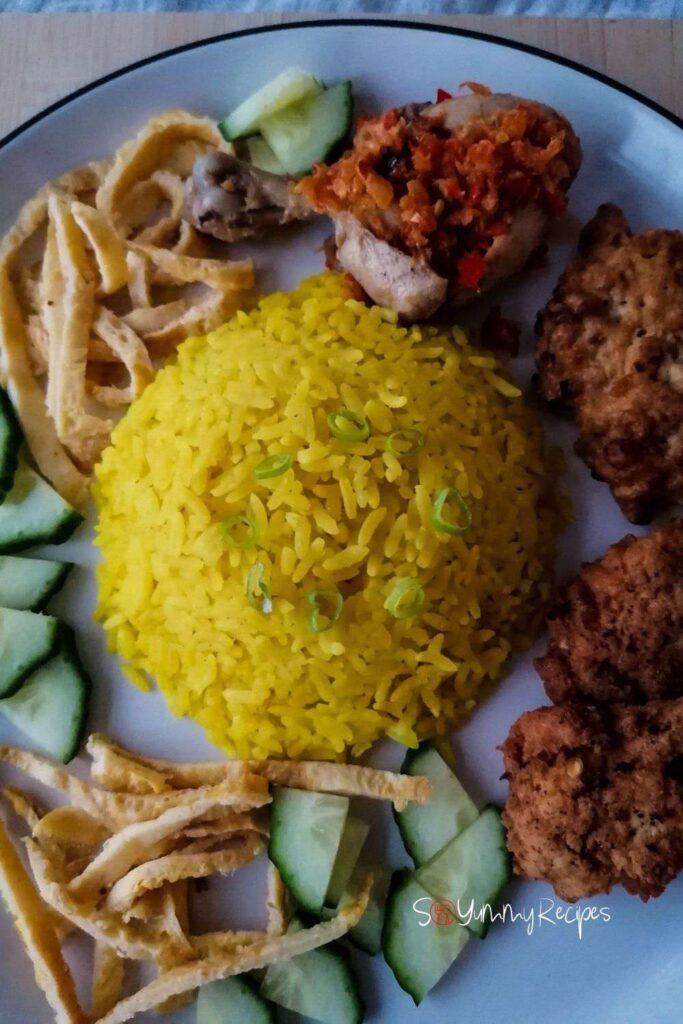
Traditionally, people mold the rice into a cone shape and place it in a large food tray, with all the side dishes and food trimmings surrounding the rice. And one will cut the tip of the cone as a part of their celebration.
This way of serving Nasi Kuning is called Nasi Tumpeng.
Nowadays, this yellow rice is enjoyed anytime, without any particular reason to celebrate.
Because the rice is so addictively yummy. It’s delicately fragranced with all those lovely tropical herbs. And the coconut milk makes the rice taste delicious.
Unique Ingredients
You don’t need a million things to cook this celebratory yellow rice. You just need rice, coconut milk, kaffir lime leaves, salam leaves, lemongrass, turmeric, lime juice, and salt.
Generally, there are two types of rice in Indonesia, Beras Pulen and Beras Pera. The latter has a texture similar to Basmati rice. The grains don’t stick together when you cook. Unless you cook it with extra water or for longer. This Beras Pera is better suited for cooking rice dishes such as Nasi Uduk. And when you’re outside Indonesia, Basmati rice is the best substitute for this rice.
The other rice type, Beras Pulen, has a sticky texture. It’s close to the texture of Thai rice. Hence, Thai rice is the ideal substitute when you’re away from Indonesia. And this rice is a good choice for Nasi Kuning. But if you can not obtain this rice, you can also use long-grain rice.
Of all the ingredients, I feel that Salam Leaves are probably the most challenging for you to obtain. Because you cannot easily get this type of herb outside Indonesia. At least, I’ve never seen any grocery sellers selling Salam leaf in the UK. The only option is online shopping.
If you can’t get Salam Leaf, I find the best substitute is the mix of curry leaves and bay leaves. For this recipe, 3 curry leaves and 1 bay leaf will be sufficient.
But please don’t just use bay leaves. Because the fragrance will be totally different from how it should be. Bay leaves will remind you of Mediterranean food, not Southeast Asian food.
The Traditional Way of Making Indonesian Yellow Rice
The traditional way to make Nasi Kuning is to boil and steam the rice.
I must admit that this old-fashioned way can be time-consuming. But the end result is far superior quality.
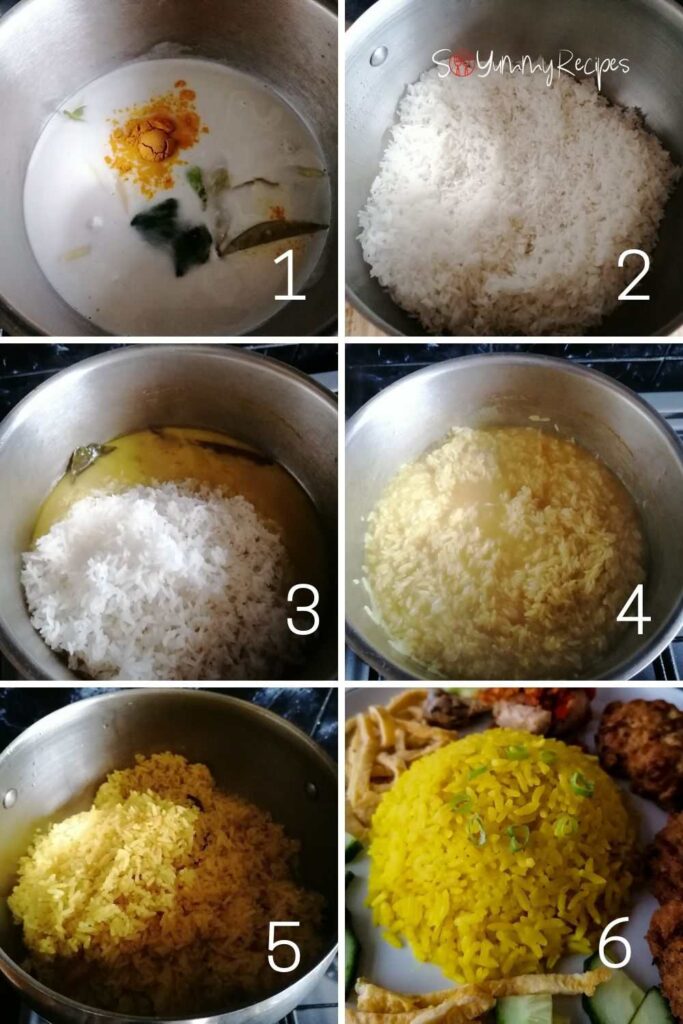
So, before you boil the rice in the coconut milk, first cook it with the herbs and lime juice until it’s shiny, and some oil has separated from the edges.
At the same time, you also need to wash the rice and then steam it. This way, the rice grains won’t go hard when you cook them in the coconut milk
After you prepare the rice and coconut milk, cook them together until the coconut milk has evaporated. Ensure you stir every now and then to prevent the rice from sticking to the bottom of the pan.
Once the milk has evaporated, return the rice to the steamer over medium-high heat and steam until fully cooked. It takes me about 15-20 minutes.
Cooking Nasi Kuning in a Rice Cooker or Instant Pot
If you want, you can cook Nasi Kuning in a rice cooker or an Instant Pot. This method is, needless to say, very practical and requires little effort.
Wash the rice until the water runs clear, drain it, and set it aside.
Get the coconut milk ready by boiling it with the herbs and lime juice until it looks shiny. You can see oil separating from the edges.
Put the washed rice, coconut milk, and all the herbs into the bowl of your rice cooker or Instant Pot. Set your appliance to cook the rice according to the instructions in its manual. And let your kitchen gadget do the job.
A regular rice cooker takes approximately 25-35 minutes, and an Instant Pot takes approximately 10-15 minutes to cook this yellow rice. And you don’t have to do much, really.
Storing Matter
Like any rice dish, you can keep your nasi kuning in the fridge/ refrigerator for 4-5 days. Provided you store it in a tight-lidded food container.
You can also freeze it; it keeps well for about 6-8 weeks. Just make sure you let it thaw in the fridge overnight before you serve or eat it.
And reheat the rice by steaming it. This way, it will stay moist and fluffy.
Side Dishes to Have With Nasi Kuning
There is no limit to what you can enjoy alongside this delicious Nasi Kuning. You can have it with pretty much anything you fancy, really.
As a rule of thumb, you want to choose some dried stuff without too much gravy. Because any gravy may take away the flavor of your Nasi Kuning.
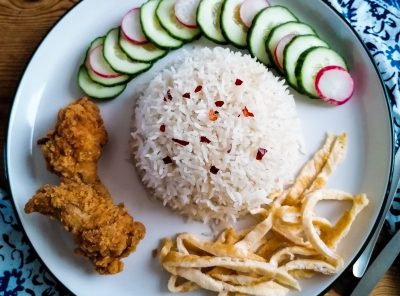
Some ideas for you are Ayam Goreng Bumbu (spicy fried chicken), Ayam Penyet (smashed chicken with chili sambal), Perkedel Tempe (tempeh fritters), Perkedel Jagung (sweetcorn fritters), Sambal Goreng Terasi (chili with dried shrimp paste), sliced egg omelets, and some vegetables, etc.
More ideas for Indonesian food recipes
Don’t forget to check my other Indonesian food recipes that you may like. You can try lamb tongseng, sate ayam, lamb satay (sate kambing), or beef rendang.
Thank you for reading this nasi kuning recipe. I hope you’re now planning to try it. It would be awesome if you could share your thoughts in the comments below (leave a reply).
Lastly, please follow me on Facebook, Instagram, and/or Pinterest. To sneak a peek at what’s cooking in my kitchen.
Take care and all the best.

Nasi Kuning – Indonesian Yellow Rice In Fragrant Coconut Milk With Turmeric
Equipment
- Mixing bowl.s
- Cooking pan with lid.
Ingredients
- 1.1 pounds Jasmine rice or long-grain rice. Approximately 2½ cups.
- 3 cups of coconut milk.
- 2 kaffir lime leaves.
- 2 salaam leaves see the note.
- 1 lemongrass.
- ½ teaspoon turmeric powder see the note.
- 1 ¼ teaspoons salt or according to taste I use Himalayan salt.
- 1 teaspoon lime juice.
Instructions
- Place the coconut milk, kaffir lime leaves, salaam leaves (if using), lemongrass, lime juice and turmeric in a large cooking pot. Heat it to boil at moderate-high heat. Once the coconut milk reaches boiling point, leave it to simmer for about 10 minutes or until the milk is cooked and fragrant. You can see the milk looks shiny with a little bit of oil on the edges.
- Using the Steamer on the Cooker/ Stove
- At the same time, wash the rice until the water runs clear. Drain the rice and steam it for about 25 minutes until it is half cooked. Set aside.
- Put the rice in the cooked coconut milk and continue cooking until all the milk evaporates.
- Stir the rice every now and again to make sure it doesn’t stick at the bottom of the pot.
- Once the milk evaporates, transfer the rice to the steamer. And steam the rice for about 20-30 minutes until it’s fully cooked.
- Serve your Nasi Kuning with all the sides that you like.
- Using a Rice Cooker or an Instant Pot
- Wash and drain the rice until the water runs clear.
- Place the washed rice, the cooked coconut milk and all the herbs in the bowl of your rice cooker/ instant pot. Set the cooker/ IP to cook the rice as per manual instruction. Typically, it takes about 25-35 minutes to cook in a rice cooker and approximately 10-15 minutes to do it in an instant pot. It can vary according to the appliance brand.
Notes
- Make sure you boil the coconut milk until it’s really cooked and looks shiny. The best is when a little bit of oil slightly separates from the edges. Or your rice won’t taste nice.
- If you don’t have salam leaf, you can substitute it with a mix of curry leaves and a bay leaf. For this recipe, 3 curry leaves with 1 bay leaf are more than enough.
Nutrition

Devy founded So Yummy Recipes to share her love of food after exploring various cultures and cuisines for more than two decades. Her mission is to help others easily recreate traditional and non-traditional food with readily available ingredients. Her works have been featured in Reader’s Digest, Al Jazeera, MSN, Yahoo, Bon Appétit, and more.


Sign me up for this! It looks so flavorful and such a great side dish with so many options!
All I can say it’s worth a try. Do yourself favour by spoiling yourself with this one 🙂
Cravings satisfied! Perfect pair with spicy fried chicken, Love it!
Good choice.
This was so delicious. My family devoured it and sadly I had no leftovers. Thanks!
I’m glad your family like it. Well, you can always make it again, right? 😉
If using a rice cooker, should the coconut milk and other ingredients still be boiled and simmered on the stove top before adding it to the rice cooker? Thank you! Can’t wait to try it!
Yes, actually this the best way. Though I know some people who put everything raw in the cooker. But I prefer to pre-cook the coconut milk before adding to the rice. I have updated the post and the recipe card now. Thank you for your reminder. Happy cooking.
I’m glad your family like it. Well, you can always make it again, right? 😉
We eat a lot of rice and this was one of the nicest rice side dishes I’ve ever made. Delicious!
Aww, thank you. So happy that you enjoyed it.
Aww, thank you. So happy that you enjoyed it.
Interesting recipe! I haven’t really tried Indonesian dishes. This one’s worth trying!
Thank you. I hope you like it.
Can you elaborate how much lemongrass? It only says 1…
Hi, this is for one stalk/ piece of lemongrass.
Should the lime juice be added to the rice with the other ingredients while it is cooking or mixed in after the rice is done? Sorry if you mentioned this and I missed it! I’m really looking forward to making this tonight, along with Beef Rendang!
I’m not sure how I missed this lime juice in the recipe. I have updated the post and the recipe card now. Basically you put the lime juice in the coconut milk with all the herbs. The idea is to make sure we get bright and bold colour of turmeric by adding this little acid. Happy cooking. Sounds like you have a delicious menu there. You make me hungry.